Health Insurance Is Justice for All, by Merri Rudd

ABQJournal Online » Health Insurance Is Justice for All

By Merri Rudd / Former Bernalillo County probate judge on Mon, Jul 2, 2012
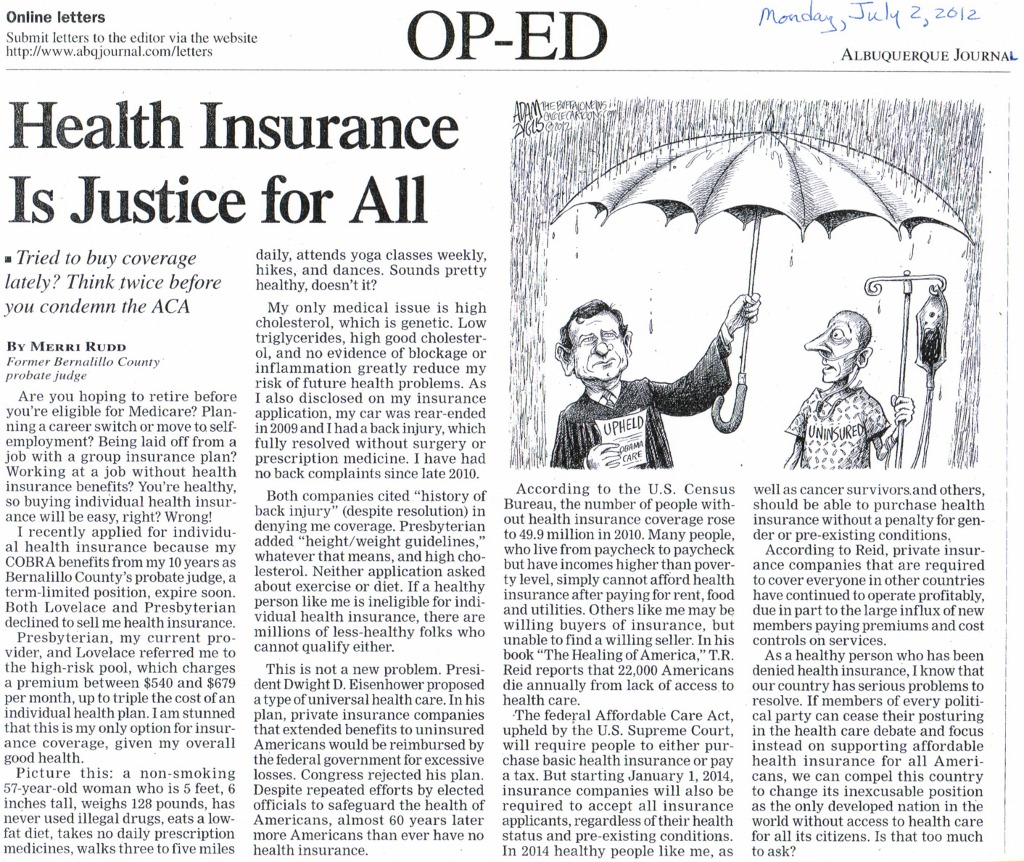
Are you hoping to retire before you’re eligible for Medicare? Planning a career switch or move to self-employment? Being laid off from a job with a group insurance plan? Working at a job without health insurance benefits? You’re healthy, so buying individual health insurance will be easy, right? Wrong!

I recently applied for individual health insurance because my COBRA benefits from my 10 years as Bernalillo County’s probate judge, a term-limited position, expire soon. Both Lovelace and Presbyterian declined to sell me health insurance.

Presbyterian, my current provider, and Lovelace referred me to the high-risk pool, which charges a premium between $540 and $679 per month, up to triple the cost of an individual health plan. I am stunned that this is my only option for insurance coverage, given my overall good health.

Picture this: a non-smoking 57-year-old woman who is 5 feet, 6 inches tall, weighs 128 pounds, has never used illegal drugs, eats a low-fat diet, takes no daily prescription medicines, walks three to five miles daily, attends yoga classes weekly, hikes, and dances. Sounds pretty healthy, doesn’t it?

My only medical issue is high cholesterol, which is genetic. Low triglycerides, high good cholesterol, and no evidence of blockage or inflammation greatly reduce my risk of future health problems. As I also disclosed on my insurance application, my car was rear-ended in 2009 and I had a back injury, which fully resolved without surgery or prescription medicine. I have had no back complaints since late 2010.

Both companies cited “history of back injury” (despite resolution) in denying me coverage. Presbyterian added “height/weight guidelines,” whatever that means, and high cholesterol. Neither application asked about exercise or diet. If a healthy person like me is ineligible for individual health insurance, there are millions of less-healthy folks who cannot qualify either.

This is not a new problem. President Dwight D. Eisenhower proposed a type of universal health care. In his plan, private insurance companies that extended benefits to uninsured Americans would be reimbursed by the federal government for excessive losses. Congress rejected his plan. Despite repeated efforts by elected officials to safeguard the health of Americans, almost 60 years later more Americans than ever have no health insurance.

According to the U.S. Census Bureau, the number of people without health insurance coverage rose to 49.9 million in 2010. Many people, who live from paycheck to paycheck but have incomes higher than poverty level, simply cannot afford health insurance after paying for rent, food and utilities. Others like me may be willing buyers of insurance, but unable to find a willing seller. In his book “The Healing of America,” T.R. Reid reports that 22,000 Americans die annually from lack of access to health care.

The federal Affordable Care Act, upheld by the U.S. Supreme Court, will require people to either purchase basic health insurance or pay a tax. But starting January 1, 2014, insurance companies will also be required to accept all insurance applicants, regardless of their health status and pre-existing conditions. In 2014 healthy people like me, as well as cancer survivors and others, should be able to purchase health insurance without a penalty for gender or pre-existing conditions.

According to Reid, private insurance companies that are required to cover everyone in other countries have continued to operate profitably, due in part to the large influx of new members paying premiums and cost controls on services.

As a healthy person who has been denied health insurance, I know that our country has serious problems to resolve. If members of every political party can cease their posturing in the health care debate and focus instead on supporting affordable health insurance for all Americans, we can compel this country to change its inexcusable position as the only developed nation in the world without access to health care for all its citizens. Is that too much to ask?


Socialism designed by the War Dept and benefiting business

Mad Hatters would battle this all the way, demanding each state decide for itself with funding through non-stop corporate ads (oh, wait, we have that already). mjh

So This is Nebraska by Ted Kooser | The Writer’s Almanac with Garrison Keillor

It was on this day in 1956 that President Eisenhower signed the Federal Highway Act, which established the Interstate Highway System.

The Interstate Highway System had been in the works for a while. During World War I, the Army determined that the condition of national roads needed to be improved for national defense, so they produced a map for the government of the major routes they felt were important in the event of war. In 1938, President Roosevelt drew out a map of "superhighways" to cross the country.

The American public had its first taste of the a "superhighway" system in 1939, at the New York World’s Fair. The most popular exhibit there was the General Motors Futurama ride, which showed a vision of the future in 1960. Fairgoers sat in chairs that moved through a diorama of the future America, where everyone owned a car and the entire country was connected by freeways. On these freeways, the lanes going in one direction were separated from the traffic coming from the other direction. Drivers could go up to 50 mph, and could travel from one coast to the other without a single traffic light. These ideas were so exciting that 28,000 people attended the Futurama exhibit every day.

As a general during World War II, Eisenhower was impressed by Germany’s autobahn system, and he decided that the United States needed something comparable. After the war, the economy was booming, and Eisenhower decided the time was right to push through the Interstate Highway System. It was the largest public works project in American history. It took longer than expected to build—35 years instead of 12—and it cost more than $100 billion, about three times the initial budget. But the first coast-to-coast highway, Interstate 80, was completed in 1986, running from New York City to San Francisco.

It was a great boon for hotel and fast-food chains, which sprung up by interstate exits. It was also a boon for suburban living, since commuting was faster and easier than before.

But it was not necessarily good for American literature.

So This is Nebraska by Ted Kooser | The Writer’s Almanac with Garrison Keillor

US health care ranks 37th in the world

Makes you proud, don’t it. mjh

Eugene Robinson: The Supreme Court, helping to heal the nation – The Washington Post

The World Health Organization gives the U.S. health system an overall ranking of 37th in the world, far below other Western democracies. The CIA World Factbook — hardly the work of a bunch of left-leaning one-worlders — reports that life expectancy in the United States is not just lower than in other industrialized countries but also lower than in Jordan and Bosnia.Infant mortality in this country, according to the CIA, exceeds that of Slovenia and Cuba. It is possible to quibble with these figures but not to ignore them. We should be ashamed of ourselves.

Eugene Robinson: The Supreme Court, helping to heal the nation – The Washington Post

Here are some Health Care Reform changes you already benefit from

Republicans were for it until Obama joined them. Then it became unacceptable. Next time you vote, remember that every single Republican will work to completely undo the good parts of health care reform. mjh

Supreme Court Upholds Health Reform Law

What are some changes that have already taken place because of the law?

About 3.1 million young adults gained health insurance through a provision that allows them to stay on their parents’ policies until age 26. In addition, nearly 62,000 Americans with pre-existing health conditions, who would otherwise be uninsurable, gained coverage through the government’s Pre-Existing Condition Insurance Plans (PCIPs). Those enrolled will be able to stay in the program until it expires in 2014. At that time, they’ll be eligible to buy health insurance through state-based insurance marketplaces scheduled to be up and running by fall 2013.

Other consumer protections already in effect include:

  • The right to appeal an insurer’s decision
  • Preventive care with no co-pay
  • Guaranteed insurance coverage for children under the age of 19 with pre-existing conditions
  • Drug discounts for people on Medicare
  • No more lifetime limits on health insurance spending
  • Review of suspected unreasonable insurance rate increases
  • The requirement that insurance companies spend at least 80% of the money they collect on medical expenses (this 80/20 rule so far means 12.8 million Americans will participate in $1.1 billion in rebates from insurance companies this summer, according to the HHS)
What does this ruling mean for small businesses?

So far, an estimated 4.4 million small businesses that provide employee health insurance are eligible for a 35% tax credit to offset the cost of insurance premiums (as of mid-May 2011, only about 228,000 small business owners claimed the credit).

To qualify, a business must employ fewer than 25 employees and the average company salary must be less than $50,000. Businesses must also pay at least half of workers’ health insurance costs.

These tax credits will remain in effect, and will increase to 50% starting in 2014.

Companies with more than 50 employees will be required to provide workers’ insurance or pay a fine.

Supreme Court Upholds Health Reform Law

"It does not require a majority to prevail, but rather an irate, tireless minority keen to set brush fires in people's minds." — Sam Adams