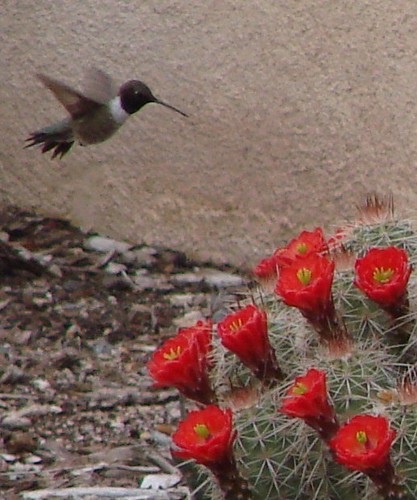
Bokeh is the English spelling of a Japanese word. I pronounce it ‘bowkay.’ Most simply, bokeh refers to the blurring of areas of a photograph. Bokeh is a natural bi-product of depth-of-field (DOF), that aspect of photography that is so very different from vision.
As you move your eyes around the world, everything is always in focus. (For the sake of argument, ignore glasses, exhaustion, alcohol, and coffee.) But cameras have variable depth-of-field (DOF), in which objects some distance from the lens are in focus, but objects closer or farther – outside the DOF – are not in focus / are blurred. That depth – the distance from the lens – can be shallow (more of the foreground/background is likely to be blurred) or deep (more of the scene is likely to be in sharp focus).
Recognizing that all of the settings on a camera are interdependent, aperture – the size of the lens opening — controls depth-of-field. Simply put, with automatic settings, a bright scene is likely to be in focus nearer and farther. As the scene gets darker, automatic settings *may* increase the aperture (open the lens for more light), which reduces the depth-of-field. (The camera *may* instead slow the shutter to give more time for light to enter the lens or adjust the light sensitivity (ISO) of the sensor/chip.)
You can assert some control over DOF if your camera has Aperture Priority (A or AP on the controls), but your camera may not have true DOF preview — or that may be hard to see — so remember the camera and the eye don’t see exactly the same scene.
Scene settings for Portrait (a head-and-shoulders icon) often reduce the DOF because someone thinks portraits look cooler if everything else is blurry.
Be aware that the macro (close-up) setting (usually a flower icon) has a very shallow depth-of-field. Further, a zoom lens affects DOF, dependent in part on your distance from the subject, as well as the distance between the subject and the background. All of the shots in this entry are zooms. (I think it’s a coincidence that all have yellow and most are flowers.)
Experiment by taking several photos from the same position while changing settings and by moving closer or farther and repeating your play. Move left and right, as well, because that may change the distance between the subject and objects in the background.

 Digiscopy or digiscoping involves combining a camera with a (tele)scope for far-reaching zoom close-ups. The best shots probably involve a mechanism for mounting the camera to the scope. (Or one of Zeiss’ awesome but expensive photoscopes – not a product placement.) I just hold the camera up to the scope eyepiece and jiggle, twist, and zoom in or out until I think I see an image on the LCD, then shoot. As a result, these are my very best digiscope shots. Still, I’m intrigued by the possibility. (And would accept a nice scope as a gift.) I’m sure someone would prefer to crop these photos, but I actually like the shape of the scope. (No doubt, there is a Photoshop mask to “make you photos appear as if digiscoped.”)