word-hoard \WURD-hawrd\ , noun:
A person’s vocabulary.
The NRA are cowards afraid of data and facts
What We Don’t Know Is Killing Us – NYTimes.com
But that is precisely what the National Rifle Association and other opponents of firearms regulation do not want. In the absence of reliable data and data-driven policy recommendations, talk about guns inevitably lurches into the unknown, allowing abstractions, propaganda and ideology to fill the void and thwart change.
The research freeze began at a time when the C.D.C. was making strides in studying gun violence as a public health problem. Before that, the issue had been regarded mainly as a law enforcement challenge or as a problem of disparate acts by deranged offenders, an approach that remains in sync with the N.R.A. worldview.
Public health research emphasizes prevention of death, disability and injury. It focuses not only on the gun user, but on the gun, in much the same way that public health efforts to reduce motor vehicle deaths have long focused on both drivers and cars.
The goal is to understand a health threat and identify lifesaving interventions. At their most basic, gun policy recommendations would extend beyond buying and owning a gun (say, background checks and safe storage devices) to manufacturing (childproofing and other federal safety standards) and distribution (stronger antitrafficking laws), as well as educating and enlisting parents, physicians, teachers and other community leaders to talk about the risks and responsibilities of gun ownership. …
To understand and prevent motor vehicle deaths, for instance, the government tracks more than 100 variables per fatal crash, including the make, model and year of the vehicles, the speed and speed limit, the location of passengers, seat belt use and air bag deployment.
Guns deaths do not get such scrutiny. That does not mean we do not know enough to act. The evidence linking gun prevalence and violent death is strong and compelling; international comparisons are also instructive.
But we need more data to formulate, analyze and evaluate policy to focus on what works and to refine or reject what does not. How many guns are stolen? How do guns first get diverted into illegal hands? How many murderers would have passed today’s background checks? What percentage of criminal gun traces are accounted for by, say, the top 5 percent of gun dealers? How many households possess firearms: is it one-third as some surveys suggest, or one-half?
Happy Wolf Moon!
A-OOOoooo!
Spike calling from the roof
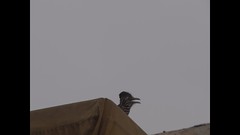
Spike calling from the roof
Spike the roadrunner is calling
 We’ve been interacting with Spike the roadrunner for about 6 months. We see him almost daily. He’s not a pet – he’s leery of us, as he should be – but we know each other.
Spike has recently started calling, a sound we’ve never heard before. We’re familiar with the roadrunner call that sounds much like a mourning dove only more mournful. This call is a loud whoop. You can hear it in the first short video. I took the second video immediately after the call.
 It’s warm and rainy in Albuquerque today – to call that unusual is tragic understatement. Spike has hunkered down on his rock in the front yard in a pose that reminds me of green herons or black-crowned night herons – no neck.
Spike the roadrunner is calling is a post from: Ah, Wilderness!. Thank you for subscribing. Let me know what you think. peace, mjh
My 1,700-mile hike across the XL Pipeline – Salon.com
Well worth reading. peace, mjh
My 1,700-mile hike across the XL Pipeline – Salon.com
I wanted to learn everything about the environmental battle. I saw a country marked by apathy, and flickers of hope
By Ken Ilgunas
On a cool morning in September 2012, I strapped on my backpack, stuck out my thumb north of Denver, Colo., and hitchhiked 1,500 miles to the Alberta Tar Sands. After viewing the Tar Sands — a horizon-to-horizon Ayn Rand wasteland of bulldozed Boreal Forest, eerie yellow sulfur pyramids, and Armageddon-black tailing ponds — I hitchhiked south to Hardisty, Alberta, the northern terminus of the pipeline-to-be, where I’d begin my hike. My ultimate destination would be Port Arthur — an oil refinery city on the Gulf Coast of Texas, which would be the southern terminus of the XL. …
More than just another pipeline, the XL, to me, is a historic battleground: the first-ever fight — led by Bill McKibben and his organization 350.org — over a project because of climate change. Even if its path would lead me through the “middle of nowhere,” with the fate of a warming world at stake, I thought of the XL as the center of the universe. And I wanted to be there and learn everything I could about it.
If President Obama approves the XL — which he may or may not do in the next few months — the Tar Sands of northern Alberta will continue to be developed (perhaps to the size of Florida), a prospect that one climate scientist has called “game over” for climate change.
