Get off the lawn!
Flying Swords of Dragon Gate (2+ stars)
From Hark Tsui, the director and producer of Inspector Dee, and countless others, and featuring Jet Li, whose IMDB profile lists 45 movies, this movie has its moments. After all these years, I’m surprised to see new weapons like the daggers with hooks that cause them to spin around and fly off in new directions, often pulling out another dagger, sending both flying. Or swords that shatter into spinning boomerangs. Like Inspector Dee, FSDG features several very interesting looking actors — compelling figures. I especially enjoyed the Tartars or Mongols (identified as both) whose faces are covered with tattoos. As in many of these films, there may be more powerful females than males, certainly no fewer. And lovers are brooding and doomed to separation. If you think two guys sword-fighting inside a tornado must be the end, there’s another half hour after that, with a few surprises, even. Not that I’m recommending this movie.
Flying Swords of Dragon Gate (2011) – IMDb
Set three years after Dragon Inn, innkeeper Jade has disappeared and a new inn has risen from the ashes – one that’s staffed by marauders masquerading as law-abiding citizens, who hope to unearth the fabled lost city buried in the desert.
Director: Hark Tsui
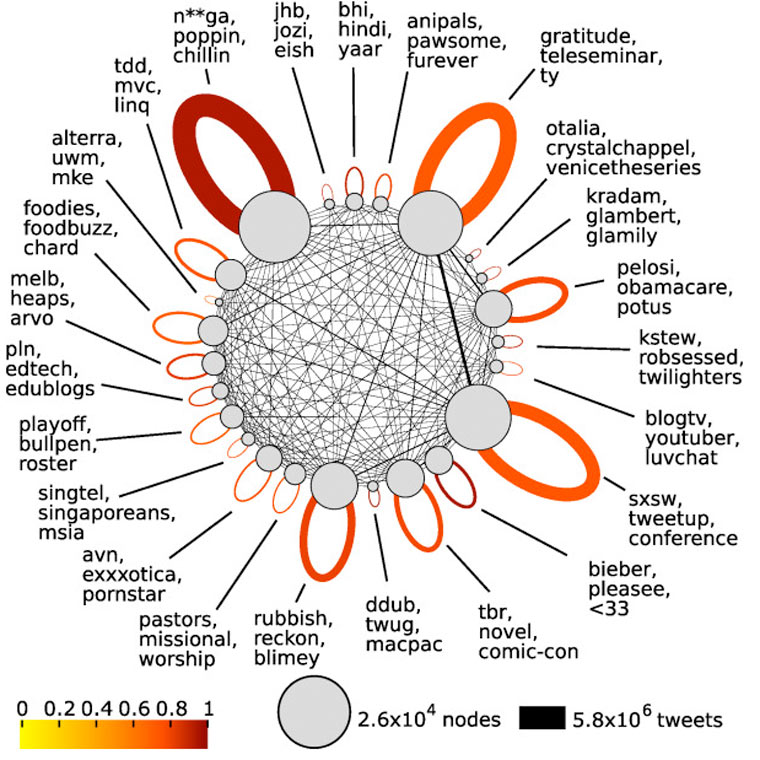
Twitter users forming tribes with own language, tweet analysis shows | News | guardian.co.uk
I think the format of the graphic is particularly intriguing. However, I question the “algorithm” that assigns tweets to tribes. Moreover, where are the nerds, surely the largest tribe of all on Twitter. peace, mjh
Twitter users forming tribes with own language, tweet analysis shows | News | guardian.co.uk
Anatomy of a poison | Wheat Belly Blog
What I find most interesting about this is that it should be scientifically verifiable (or refutable). In Wheat Belly, Dr Davis doesn’t make vague assertions about diet and health. He offers evidence of a wide range of ills caused by modern wheat and alleviated by eschewing wheat. peace, mjh
Anatomy of a poison | Wheat Belly Blog
Image Fasano 2013
Note the following on the gliadin “map”:
Red = direct cytotoxic segment (intestinal cell-destroying)
Light green = immune-stimulating segment (responsible for celiac disease)
Blue = bowel permeability segment (via zonulin activation)
Dark green = inflammatory interleukin release

Given St. Pat’s and Cinco de Mayo, it’s a wonder non-Jews don’t get drunk on Rosh Hashanah
Maybe they do.
[fixed typo in original that changed “don’t” into “done.”]
Coffee and Green Tea May Help Lower Stroke Risk – WebMD
Good news for some of us. peace, mjh
Coffee and Green Tea May Help Lower Stroke Risk
The new study found:
- People who drank at least 1 cup of coffee daily had about a 20% lower risk of stroke compared to those who rarely drank it.
- People who drank 2 to 3 cups of green tea daily had a 14% lower risk of stroke, and those who had at least 4 cups had a 20% lower risk, compared to those who rarely drank it.
- People who drank at least 1 cup of coffee or 2 cups of green tea daily had a 32% lower risk of intracerebral hemorrhage, compared to those who rarely drank either beverage. Intracerebral hemorrhage happens when a blood vessel bursts and bleeds inside the brain. About 13% of strokes are due to this condition.
Researchers adjusted their findings to account for age, sex, and lifestyle factors like smoking, alcohol, weight, diet, and exercise. Green tea drinkers in the study were more likely to exercise than non-drinkers.
Hate Other People’s Cellphone Calls? You’re Not Alone – WebMD
Seems obvious to me: we’re hard-wired to listen. There is evolutionary benefit to listening; not listening has negative impact (“there’s a deadly spider on your neck.”). Some people may have become more conscious of this as a problem due to cellphones, but I struggle with this in crowded restaurants, etc. It’s why you want to kill the talkers behind you in a theater. You can’t tune out because your ancestors’ survival depended on it. But, I’ll wait while scientists do their job their way and confirm this later on. peace, mjh
Hate Other People’s Cellphone Calls? You’re Not Alone – WebMD
According to the researchers, people appear to be less able to tune out cellphone conversations compared to two-person exchanges. This supports notions that overheard cellphone jabber might negatively affect a person’s ability to concentrate and focus, they said.
Galvan said it remains unclear exactly why this is so.
"We didn’t study why cellphone conversations are more distracting," she noted. "But there’s a lot of research that shows that [mental] multitasking isn’t really possible. That your brain actually has to switch back and forth between listening in and doing something else, rather than doing both tasks at the same time."
"And it also could be a question of control," Galvan added. "Bystanders to these conversations lack any control over whether someone in public answers their phone and shares personal information the bystander doesn’t really want to hear. And that lack of control could be stressful. Of course that could be true of a two-way conversation too. So we’ll need more research to try and figure this out."
For her part, Lauren Emberson, the lead author of the 2012 study and now a postdoctoral associate in the department of brain and cognitive sciences at the University of Rochester, said the findings were "not surprising."
"I think it’s important to know that this is not about people eavesdropping," she said. "Our brains are just naturally drawn to things we know less about that are informationally rich and spark our curiosity. It really is beyond people’s control."
Her advice? "I think this work speaks to etiquette," she said. As "people become more aware of the issue, there will be more and more pressure for people not to make calls in a public space where people can’t escape."
Evolving technology may even offer at least a partial solution, Emberson said.
"People are using their phones more and more for texting, rather than talking, so while this will probably always be relevant it might actually become less of a problem. But maybe I’m just an optimist."
Hate Other People’s Cellphone Calls? You’re Not Alone – WebMD