You know how you anticipate the odometer rolling over to a bunch of zeros? You watch, perhaps for months. You get down to just a few dozen more miles and then you look and you missed it — damn!
So it is with a couple of numbers on Flickr, my photoblog. For all I know, both numbers rolled over at the same moment — I missed them both. One is the number of photos I’ve uploaded, now beyond the 666 I was watching for. Fittingly, though unintentionally, this was #666. The other flickr count is the number of views, now over 10,000 (which is certainly not the number of people who have seen my photos). I have two pictures that have been viewed more than 400 times, but most garner 3-5 views by themselves (as opposed to viewing on a page with others). Posting to the The Duke City Fix Pool usually pulls in 30 to 50 views.
Meanwhile, the other number I watch far too closely — my book’s rank on Amazon — lurched above 100,000 yesterday (not a good thing). I need more reviews, perhaps.
Don’t ask me about my cholesterol or blood pressure. I’ve got other numbers on my mind.
For some, math is a religion. There is no better tool for measuring reality while looking for the truth, the grail of science. But if humans didn’t exist, math wouldn’t either. (Leaving aside speculation about how other intelligent lifeforms measure the Universe.) And while I hesitate to suggest 47 is as important as pi, the appreciation of any number is subjective and arbitrary. In that weird way, all numbers are equal. mjh
Category Archives: Uncategorized
Categorically, All Things Uncategorized.
afterlife
As with your kind, our time alive is limited. When the end comes, the dying fall to the ground engulfed in flames of spontaneous generation. By our custom, those nearby sit and wait and contemplate their own inevitable end. Some say the fire that consumes us reflects some quality of character — sometimes, raging red, others cooler blue. When the flames die down, very little ash remains, but in the center of that ash is what we call the afterlife, a stone the size of your heart, ranging from clear to jet black. By custom, the afterlife belongs to the family. Some families keep generations of afterlife, building temples to house them. Some leave the afterlife in a place special to the departed and so you may come across one of these stones in an unexpected place. Your kind owes ours no reverence, though moving these stones is inconsiderate, at best. You might better take a moment to contemplate your own afterlife. mjh
The Longest Daze
I was surprised to learn some years ago that the latest sunset does not occur on the Summer Solstice, nor the earliest sunrise. Curiously, the days grow shorter and the sunsets later. A similar discrepancy occurs with the Winter Solstice. I was doubly surprised that I could grow so old and pass so many solstices before learning that and never observe it myself. And I thought I was educated.
To those few readers who noticed a long pause in my entries, thank you for noticing and for coming back. Forgive me, but the next few entries may be downers. Stay with me. mjh
PS: Please look at my Flickr photos. I’m depressed that so few people have seen what I regard as one of the best pictures I’ve ever taken. I have many newer pix to post but can’t bare for this one to sink unseen. Yes, that’s my heart you see on my sleeve.
Snake Handlers
Our neighbors called yesterday early evening to say a snake was on their porch. We ran across the street to find J using a push-broom to sweep a 3+ foot long brown and yellow snake away from the house. It moved like a wave in front of the broom. J & S hate snakes; S wouldn’t come out of the house. I heard fear more than hatred in J’s voice. I took a couple of photos that turned out blurrier than a hummingbird’s wing. Then I used the broom to sweep the snake away from J & S and towards the street. Certain it wasn’t a rattler, I grabbed it from behind as close to the head as I could. It was strong as it coiled up tight against my arm. But it stopped struggling and stayed like that for the next half hour as we discussed what was best for it. The irony was I had a great photographic subject wrapped around my picture-takin’ arm. So Mer took a few. (J & S will never look at us the same after this.)
In all likelihood, it was a bull snake (or gopher snake). However, it never hissed or struck at anything, so I suspect it might have been an escaped pet — especially since we’ve never seen a snake in our mid-town neighborhood. We have experience handling a python, so we weren’t afraid. (Though I was less comfortable when someone said bull snakes have a strong bite.)
We decided we should release the snake in the foothills, but by then it was too dark. We put the snake in a pillowcase sealed with a couple of clothespins. Then we put the pillowcase in a plastic tub 6 inches deep. This morning, I looked in to see the snake coiled and still quite calm. About a half hour later, I heard a plastic cup fall over on the counter. The snake had moved — pillowcase and all — out of the tub and onto the counter, knocking over the cup. I put it back in the tub.
We drove to the foothills and walked a less-used trail a ways before striking off cross-country a short distance. Mer picked a spot near a big fractured rock with shrubs — lots of places to hide and hunt. My turn to take pictures of Mer with the snake and the city stretching away in the background. She put it on the ground and it moved magically under a shrub and vanished. Perhaps it will starve. Perhaps it will feed that roadrunner with the heavy beak we saw — or an owl, or another snake. With a 20 year lifespan, perhaps it will outlive us. I hope it remembers us, as we will it. Happy 1st day of summer to us all. mjh
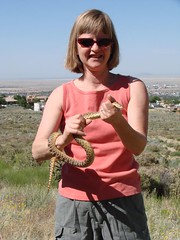
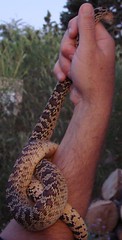
PPS: I’m struck by the synchronicity of this incident from a few days before our snake encounter. I was spinning the dial and paused briefly to watch Franklin Graham eulogize his mother. He said that as a boy, he and his brothers loved to kill snakes — rattlers, any kind of snake. One particularly good summer, they killed over 70 snakes. He spoke with pride to an appreciative audience that smiled and chuckled. I wondered what kind of religion produces such a man. God bless the atheists.
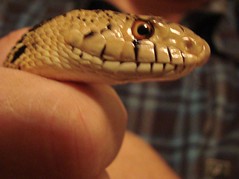
See Merri’s Save A Snake for Humanity
[mjh: With the help of a friend, I heard from UNM biologist Howard Snell. This is an excerpt from his email.]
It isn’t a good idea to move [snakes] very far as they then encounter areas that they don’t know and often die as a result of not “knowing” where to find water, shelter, and prey.
If you think the snake has been in captivity it is important not to release it in the wild. Snakes in captivity can come down with diseases & parasites (often caught from other individuals in captivity) that can then be transferred to wild snakes upon release of the previous captive.
Oops. Oh, Hell, Everyone Makes Mistakes.
We’re not “playing god” with DNA. We’re playing “not-too-bright kindergartener with razor blades.” All around the globe, people are actively manipulating genes just as top scientists say, “hey, who knew?
” My hope is that one of our inevitable blunders in genetic manipulation wipes out humankind. My respect for irony makes me fear we’ll wipe out everything else. Buy more guns today! mjh
Intricate Toiling Found In Nooks of DNA Once Believed to Stand Idle By Rick Weiss, Washington Post Staff Writer
The first concerted effort to understand all the inner workings of the DNA molecule is overturning a host of long-held assumptions about the nature of genes and their role in human health and evolution, scientists reported yesterday.
The new perspective reveals DNA to be not just a string of biological code but a dauntingly complex operating system that processes many more kinds of information than previously appreciated.
The findings, from a project involving hundreds of scientists in 11 countries and detailed in 29 papers being published today, confirm growing suspicions that the stretches of “junk DNA” flanking hardworking genes are not junk at all. But the study goes further, indicating for the first time that the vast majority of the 3 billion “letters” of the human genetic code are busily toiling at an array of previously invisible tasks. …
Complicating the picture, it turns out that genes and the DNA sequences that regulate their activity are often far apart along the six-foot-long strands of DNA intricately packaged inside each cell. How they communicate is still largely a mystery. …
“There’s a lot more going on than we thought,” said Francis Collins, director of the National Human Genome Research Institute, the part of the National Institutes of Health that financed most of the $42 million project.
“It’s like trying to read and understand a very complicated Chinese novel,” said Eric Green, the institute’s scientific director. “The take-home message is, ‘Oh, my gosh, this is really complicated.’ “
Stop Fighting
There is a chance — a hope — that one day humankind will grow up and stop killing each other en mass. Perhaps, we will all finally recognize war as futile madness. I think there is a slightly better chance we will completely destroy ourselves first. peace, mjh
Event Day Birth Happy Linnaeus Carolus
The Writer’s Almanac from American Public Media
It’s the birthday of the man who gave us a system of classifying and naming all the living things on the planet, Carolus Linnaeus, born in Råshult, Sweden (1707). He was born at a time when human beings named plants and animals in a variety of ways, usually based on what they looked like: names like Queen Anne’s Lace, ghost orchid, and sword fish. But these names were always local. Even within a single country, like England, a plant could be called by half a dozen different names by different groups of people.
Linnaeus was a botanist, and it was his goal to help import new plants to Sweden to help improve the economy. In order to keep everything straight, he developed a naming system based in Latin, so that he and his students would always know what they were talking about. He put each specimen into a large group called a genus and a smaller subgroup called a species, and this became the binomial naming system, which he published in his book Systema Naturae (1758).
Biologists found his naming system extremely useful. His ideas made him famous around the world, and scientists as well as kings and queens sent him plants and animals as gifts for his garden and zoo. Catherine the Great of Russia sent him flower seeds. The crowned prince of Sweden gave him a North American raccoon.
But Linnaeus had little success importing new crops into Sweden. The tea plants his students sent home all died. Coffee did not make it. Neither did ginger or cardamom or cotton or coconuts. In fact, rhubarb was one of the only new plants that took hold. Late in his life, Linnaeus said that the introduction of rhubarb to Sweden was his proudest achievement.
But today, we remember Linnaeus for his contribution to taxonomy. His system of naming living things has been modified, but the basic idea behind it has endured for 250 years. When he published his first taxonomy of plants in 1758, Linnaeus listed the 4,400 species of plants known to science at that time. Today, his system has been used to name more than 1.5 million species. We have Linnaeus to thank for the idea behind all those names, including our own name: Homo sapiens.
http://writersalmanac.publicradio.org/programs/2007/05/21/#wednesday
[mjh: species, genus, family, order, class, phylum, kingdom]