Category Archives: photos

Photos by mark justice hinton.

Bokeh and DOF

butterfly bokeh

Bokeh is the English spelling of a Japanese word. I pronounce it ‘bowkay.’ Most simply, bokeh refers to the blurring of areas of a photograph. Bokeh is a natural bi-product of depth-of-field (DOF), that aspect of photography that is so very different from vision.

As you move your eyes around the world, everything is always in focus. (For the sake of argument, ignore glasses, exhaustion, alcohol, and coffee.) But cameras have variable depth-of-field (DOF), in which objects some distance from the lens are in focus, but objects closer or farther – outside the DOF – are not in focus / are blurred. That depth – the distance from the lens – can be shallow (more of the foreground/background is likely to be blurred) or deep (more of the scene is likely to be in sharp focus).

Recognizing that all of the settings on a camera are interdependent, aperture – the size of the lens opening — controls depth-of-field. Simply put, with automatic settings, a bright scene is likely to be in focus nearer and farther. As the scene gets darker, automatic settings *may* increase the aperture (open the lens for more light), which reduces the depth-of-field. (The camera *may* instead slow the shutter to give more time for light to enter the lens or adjust the light sensitivity (ISO) of the sensor/chip.) 

You can assert some control over DOF if your camera has Aperture Priority (A or AP on the controls), but your camera may not have true DOF preview — or that may be hard to see — so remember the camera and the eye don’t see exactly the same scene.

Scene settings for Portrait (a head-and-shoulders icon) often reduce the DOF because someone thinks portraits look cooler if everything else is blurry.

Be aware that the macro (close-up) setting (usually a flower icon) has a very shallow depth-of-field. Further, a zoom lens affects DOF, dependent in part on your distance from the subject, as well as the distance between the subject and the background. All of the shots in this entry are zooms. (I think it’s a coincidence that all have yellow and most are flowers.)

Experiment by taking several photos from the same position while changing settings and by moving closer or farther and repeating your play. Move left and right, as well, because that may change the distance between the subject and objects in the background.

yellow flower on dark background

Bokeh and Depth of Field

Be Ready for Good Luck

When I walk around the neighborhood, I take my camera. If I don’t, I’m sure to see a roadrunner, hawk, or merlin. I don’t know if there is ONE best photography tip, but this one is on my short list: Be Ready. Ready means camera in hand, on, lens cap off.

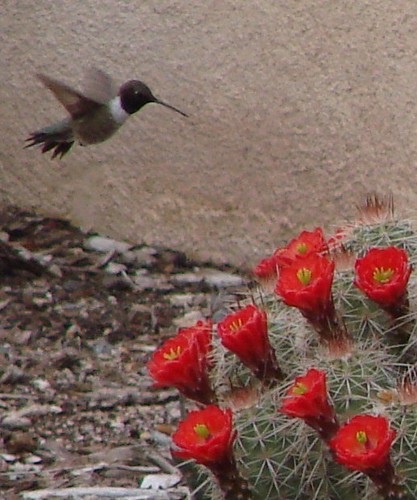
Four years ago tomorrow, I saw this hummingbird hovering just above a claret cup cactus, as I rounded a corner close to home. Imagine me standing in the middle of the street, stopping the dog in his tracks as I juggle leash and camera, frantic that I will miss this great shot, trying not to think of the cars that frequently roar around corners blindly. Fortunately for me, this was one patient hummingbird.

hummingbird and claret cup cactus

hummingbird and claret cup cactus -- cropped

On the other hand, I’ve missed a lot of great shots over the years, ready or not. And taken plenty of crappy shots with all the time in the world. I’m grateful for what I see. mjh

PS: Now, I wear a carabiner to hold the leash, so both hands are free. And the dog has learned to stop on a dime. Luke is a good photo-dog, as was Lucky before him.

Other Photographers

bosque del apache, new mexicoI’ve developed a thing for photographers. If that strikes you as narcissistic, wait until I cover self-portraits and reflections. One reason I photograph photographers is I don’t want to take the pictures other people are taking – that’s my very narrow competitive streak and also why I don’t join photography groups or outings. Another reason is I’m shy and uncomfortable photographing people, except surreptitiously. Actually, as I look these over, I realize most are not surreptitious but straight on portraits of a knowing subject. In that case, perhaps it is the difference between a duel and shooting someone who is unarmed.

A couple of these are photos of famous, professional photographers: Jeremy Stein and Bob LeBlanc, with his son, Robert. (The senior LeBlanc died earlier this year.) One more and I’ll have to declare this a subset of my category. (Oh, but I also have a photo of Susan Weeks, a fabulous watercolorist who uses photos. I’m going to slip that one into the collection.)

photographers
(20 photos)

Life Glows

 chocolate flower

This photo was an epiphany for me. Suddenly, I realized that flowers (and leaves) are translucent, not opaque. Further, I discovered the backside of flowers. In particular, this is a chocolate flower (also called green eyes). Those red veins are not visible on the face of the flower, only behind.

It doesn’t take much experience to discover that the best light of the day comes early and late. Light moves all day long. I watch for that intense light pushing through living things, setting them aglow. I feel honored to witness, let alone capture, a spotlight moment, such as these.

sunflower seedling

hollyhocks

cosmos

mimosa

sacred datura

aspen sunset, Wyoming

I recommend viewing this slideshow fullscreen. (Click the slideshow to go to the Picasa photos, then click the Fullscreen button.)

Life Glows