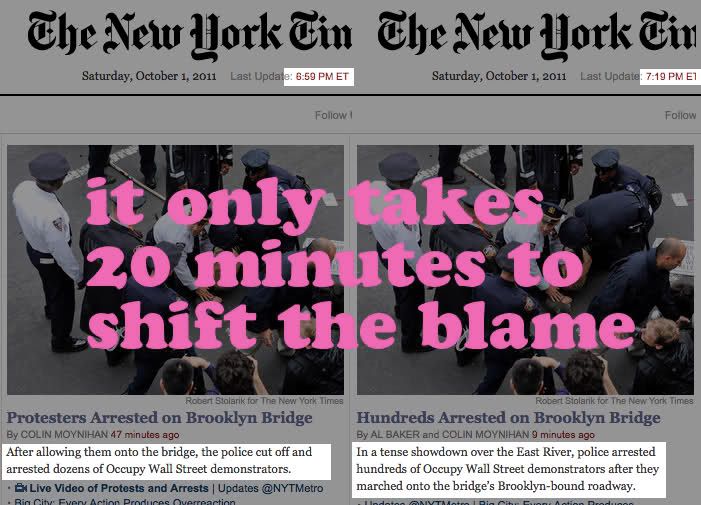
A blogger named Aluation posted this graphic showing how the New York Times changed the first line of a story about the Occupy Wall Street demonstrations. The change subtly shifted the blame for the mass arrest on the Brooklyn Bridge from the police to the protesters. In the first version of the story, police allowed them onto the bridge and then “cut off and arrested” them. In the second, there was a “showdown” in which demonstrators “marched onto the bridge.”
Adding interest, the author of the piece was changed from “Colin Moynihan” to “Al Baker and Colin Moynihan.” Who is Al Baker? He is the guy in charge of the police bureau at the Times.
According to an analysis (XLS) of Internal Revenue Service data by the economists Thomas Piketty and Emmanuel Saez, the 99 percent account for 79 percent of income in 2008, with the top 1 percent taking the other 21 percent. “That’s not that bad,” you might say. “Of course, some people are going to be richer than others.” Perhaps. But the 1 percent has been eating a bigger and bigger share of the pie over time. Back in the 1970s, the 99 percent were earning about 90 percent of income, for instance. The top 1 percent of households took a bigger share of overall income in 2007 than they did at any time since 1928.
The story goes as follows: the GOP student group at the University of California at Berkeley wanted to illustrate its opposition to pending legislation that would allow state universities to consider race, gender, ethnicity and national origin as factors in admission. So it sponsored an “Increase Diversity Bake Sale,” in which the prices varied according to race. White men were asked to pay $2 for what Asian men could get for $1.50, Latino men for $1, African-American men for 75 cents and Native American men for a quarter. All women received a 25 cent discount off those prices.
If I were going to use baked goods as a metaphor for affirmative action, my price scale would go like this: Black and Native American men would pay $10, Asian and Latino men $7 for brownies white men were able to buy for a buck, and the blacks, the Native Americans, the Asians and the Latinos would have to walk a gauntlet of gunfire, physical assault, name calling and legal roadblocks in order to reach the counter. Women would not be allowed to buy any brownies, but would be required to remain in the kitchen baking them, preferably while barefoot and pregnant.
After 350 years, the black, Latino, Asian and Native American men would get a $5 discount off the original prices (do the math) but they’d have to listen to white men carp about the gross unfairness of it all. Women would also get a discount, but would have to sweep up the bakery after it closed.
That said, I’m troubled at the response the GOP students have faced. There has been outrage, which is fair, but they say they’ve also been harassed and threatened online, which is not.
I hear all this, you know, “Well, this is class warfare, this is whatever.”—No! There is nobody in this country who got rich on his own. Nobody. You built a factory out there—good for you! But I want to be clear. You moved your goods to market on the roads the rest of us paid for. You hired workers the rest of us paid to educate. You were safe in your factory because of police forces and fire forces that the rest of us paid for. You didn’t have to worry that marauding bands would come and seize everything at your factory, and hire someone to protect against this, because of the work the rest of us did. Now look, you built a factory and it turned into something terrific, or a great idea—God bless. Keep a big hunk of it. But part of the underlying social contract is you take a hunk of that and pay forward for the next kid who comes along.
The Republicans are now the “How great is it to be stupid?” party. In perpetrating the idea that there’s no intellectual requirement for the office of the presidency, the right wing of the party offers a Farrelly Brothers “Dumb and Dumber” primary in which evolution is avant-garde. …
The occupational hazard of democracy is know-nothing voters. It shouldn’t be know-nothing candidates.
Blitzer interrupted: “But Congressman, are you saying that society should just let [someone without insurance] die?” There were enthusiastic shouts of “Yeah!” from the crowd. You’d think one of the other candidates might jump in with a word about Christian kindness. Not a peep. ..
I believe the Republican candidates’ pinched, crabby view of government’s nature and role is immoral. I believe the fact that poverty has risen sharply over the past decade — as shown by new census data — while the richest Americans have seen their incomes soar is unacceptable. I believe that writing off whole classes of citizens — the long-term unemployed whose skills are becoming out of date, thousands of former offenders who have paid their debt to society, millions of low-income youth ill-served by inadequate schools — is unconscionable.
Perry, who is leading in the polls, wants to make the federal government “inconsequential.” He thinks Social Security is a “Ponzi scheme” and a “monstrous lie.” He doesn’t much like Medicare, either.
“The first modern social insurance program began in Germany in 1889 and has been in continuous operation for more than 100 years. The American Social Security system has been in continuous successful operation since 1935. Charles Ponzi’s scheme lasted barely 200 days.”
Yesterday, Krauthammer wrote a column about the SSA Ponzi scheme. In the last paragraph, he concluded it was morally necessary and good. That’s the paragraph no conservative will quote.
"It does not require a majority to prevail, but rather an irate, tireless minority keen to set brush fires in people's minds." — Sam Adams