Media Matters by Jamison Foser
News outlets downplay Bush administration’s failure to prepare for and respond to Hurricane Katrina
So when Bush told ABC’s Diane Sawyer during an exclusive interview (video here) that nobody could have “anticipated the breach of the levees,” surely she challenged him on his claim? Surely she said, “Wait a minute, Mr. President: the Army Corps of Engineers wanted more money to prevent exactly that. They must have anticipated something. The New Orleans Times-Picayune concluded yesterday that ‘No one can say they didn’t see it coming.’ A former Republican congressman who headed the Corps of Engineers in your own administration lost his job after he publicly criticized your efforts to cut the Corps’ budget. How can you say nobody saw this coming?”
But instead, Sawyer simply moved on to her next question….
—
Guardian Unlimited | Special reports | Bush team tries to pin blame on local officials
Julian Borger in Washington
Monday September 5, 2005
The Guardian
Bush administration officials yesterday blamed state and local officials for the delays in bringing relief to New Orleans, as the president struggled to fend off the most serious political crisis of his presidency.
His top officials continued to be pilloried on television talk shows by liberals and conservatives alike, but the White House began to show signs of an evolving strategy to prevent the relief fiasco from eclipsing the president’s second term. …
Mr Bush was castigated for saying on Wednesday: “I don’t think anyone anticipated the breach of the levees”. It was pointed out that there had been a string of investigations and reports in recent years which had predicted the disaster almost exactly.
Nevertheless, administration officials stuck to the line yesterday. In a string of television interviews, Michael Chertoff, the head of the homeland security department, called the situation an “ultra-catastrophe”, as if the hurricane and flood were unrelated events. “That ‘perfect storm’ of a combination of catastrophes exceeded the foresight of the planners, and maybe anybody’s foresight,” he said. …
The depth of America’s polarisation could prove a bulwark preventing Mr Bush’s political support from collapsing altogether. A poll by the Washington Post and ABC News on Friday night, showed that, of those questioned, 46% approved of the way the president had handled the relief efforts while 47% disapproved.
—
In Disaster’s Aftermath, the Buck Stops at the President’s Desk – Los Angeles Times
The really scary thing is that few potential threats have been anticipated or studied as extensively as a devastating New Orleans flood. Last week, Bush said, “I don’t think anyone anticipated the breach of the levees.” But a chorus of experts warned for years that storm surges after a hurricane could overflow the levees, and produce the same result as the actual breach that occurred: disastrous flooding in the city.
In 2001, the Federal Emergency Management Agency identified a major New Orleans flood as one of the three most likely catastrophic disasters threatening the nation. The New Orleans Times-Picayune detailed the risks in a comprehensive investigative series in 2002. Last summer, Louisiana State University Hurricane Center participated in the “Hurricane Pam Exercise” — a Category 3 simulation — and concluded that more than a million residents would be forced to evacuate, and that as many as 300,000 others would be trapped in the city.
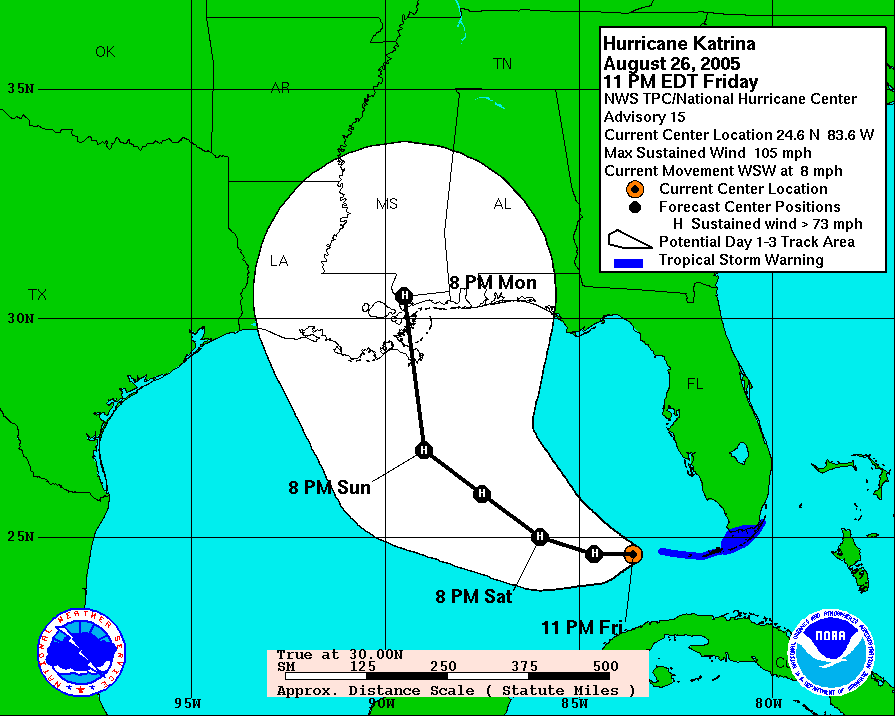
Beyond these prior warnings, Katrina, of course, was tracked for days before it hit the Gulf Coast [mjh: Katrina’s path predicted by science (not religion)]. If the local, state and federal governments were unprepared to fully cope with a disaster that had been so widely discussed and examined, and which announced its arrival so far in advance, it seems not only prudent but urgent to ask how ready we are to cope with another major terrorist strike. Presumably Al Qaeda won’t provide as much advance warning as Katrina.
—
t r u t h o u t – Paul Krugman | A Can’t-Do Government
Before 9/11 the Federal Emergency Management Agency listed the three most likely catastrophic disasters facing America: a terrorist attack on New York, a major earthquake in San Francisco and a hurricane strike on New Orleans. “The New Orleans hurricane scenario,” The Houston Chronicle wrote in December 2001, “may be the deadliest of all.” It described a potential catastrophe very much like the one now happening.
So why were New Orleans and the nation so unprepared? After 9/11, hard questions were deferred in the name of national unity, then buried under a thick coat of whitewash. This time, we need accountability. …
After 2003 the Army Corps of Engineers sharply slowed its flood-control work, including work on sinking levees. “The corps,” an Editor and Publisher article says, citing a series of articles in The Times-Picayune in New Orleans, “never tried to hide the fact that the spending pressures of the war in Iraq, as well as homeland security – coming at the same time as federal tax cuts – was the reason for the strain.”
In 2002 the corps’ chief resigned, reportedly under threat of being fired, after he criticized the administration’s proposed cuts in the corps’ budget, including flood-control spending.
Third question: Did the Bush administration destroy FEMA’s effectiveness? The administration has, by all accounts, treated the emergency management agency like an unwanted stepchild, leading to a mass exodus of experienced professionals.
Last year James Lee Witt, who won bipartisan praise for his leadership of the agency during the Clinton years, said at a Congressional hearing: “I am extremely concerned that the ability of our nation to prepare for and respond to disasters has been sharply eroded. I hear from emergency managers, local and state leaders, and first responders nearly every day that the FEMA they knew and worked well with has now disappeared.” …
Yesterday Mr. Bush made an utterly fantastic claim: that nobody expected the breach of the levees. In fact, there had been repeated warnings about exactly that risk.
—
t r u t h o u t – Molly Ivins | Why New Orleans Is in Deep Water
This is a column for everyone in the path of Hurricane Katrina who ever said, “I’m sorry, I’m just not interested in politics,” or, “There’s nothing I can do about it,” or, “Eh, they’re all crooks anyway.” …
But in addition to long-range consequences of long-term policies like letting the Corps of Engineers try to build a better river than God, there are real short-term consequences, as well. It is a fact that the Clinton administration set some tough policies on wetlands, and it is a fact that the Bush administration repealed those policies – ordering federal agencies to stop protecting as many as 20 million acres of wetlands.
Last year, four environmental groups cooperated on a joint report showing the Bush administration’s policies had allowed developers to drain thousands of acres of wetlands.
Does this mean we should blame President Bush for the fact that New Orleans is underwater? No, but it means we can blame Bush when a Category 3 or Category 2 hurricane puts New Orleans under. At this point, it is a matter of making a bad situation worse, of failing to observe the First Rule of Holes (when you’re in one, stop digging).
Had a storm the size of Katrina just had the grace to hold off for a while, it’s quite likely no one would even remember what the Bush administration did two months ago. The national press corps has the attention span of a gnat, and trying to get anyone in Washington to remember longer than a year ago is like asking them what happened in Iznik, Turkey, in A.D. 325.
Just plain political bad luck that, in June, Bush took his little ax and chopped $71.2 million from the budget of the New Orleans Corps of Engineers, a 44 percent reduction. As was reported in New Orleans CityBusiness at the time, that meant “major hurricane and flood projects will not be awarded to local engineering firms. Also, a study to determine ways to protect the region from a Category 5 hurricane has been shelved for now.” …
This, friends, is why we need to pay attention to government policies, not political personalities, and to know whereon we vote. It is about our lives.
—
The New Yorker: The Talk of the Town
THE WHITE HOUSE UNDER WATER